Earth Quake Energy Caluculator
SEISMIC ENERGY
EARTHQUAKE MAGNITUDE ANALYZER
*Each +1.0 magnitude unit corresponds to 31.6 times more energy.
JOULES (J)
Great - Massive destruction over wide areas.
Tectonic Rupture
An earthquake is the sudden release of stored elastic strain energy in the Earth's lithosphere, creating seismic waves that radiate from the hypocenter.
-
ELElastic Rebound: Rocks on opposite sides of a fault are subjected to force. They bend until they reach their breaking point, then snap back into a new position, releasing energy.
-
SWSeismic Waves: This energy travels as Body Waves (P and S waves) through the interior and Surface Waves along the crust, which cause the actual shaking we feel.
Primary (P) waves arrive first as compression, followed by Secondary (S) waves which move the ground up and down.
Richter Scale
Developed in 1935, the Richter Magnitude Scale (ML) assigns a number to quantify the energy released by an earthquake based on seismograph displacement.
-
LOGLogarithmic Growth: The scale is base-10. Each whole number increase on the scale represents a 10-fold increase in measured amplitude and roughly 32 times more energy.
-
MLLocal Magnitude: While modern scientists now prefer the Moment Magnitude Scale (Mw) for large quakes, the "Richter" terminology remains the global standard for public reporting.
A magnitude 7.0 is not "double" a 3.5; it is thousands of times more powerful.
Severity Ranges
Earthquakes are classified into ranges based on their magnitude. Each range represents a leap in destructive potential and environmental impact.
-
2.5Minor Range: Usually not felt, but recorded by seismographs. Hundreds of thousands occur annually with zero structural impact.
-
6.0Strong Range: Can cause major damage to poorly designed buildings in populated areas. Felt up to hundreds of miles from the epicenter.
-
8.0+Great Range: "Mega-quakes" capable of total destruction. These occur along major plate boundaries and can permanently alter local geography.
TNT Equivalent
The TNT Equivalent is a convention used to express the energy released in an earthquake by comparing it to the energy released by the detonation of metric tons of TNT.
-
EEnergy Unit: One gram of TNT releases roughly 4,184 Joules. Therefore, 1 Ton of TNT equals $4.184 \times 10^9$ Joules of seismic energy.
-
477tScale Example: An earthquake with a 477-ton TNT yield roughly correlates to a Magnitude 4.0 quake—strong enough to be felt by everyone but usually not causing structural collapse.
Equivalent to the energy released by approximately 15 large semi-trucks full of high explosives detonating at once.
Severe Intensity
The Modified Mercalli Intensity (MMI) scale quantifies the effects of shaking on people, objects, and buildings at a specific location.
-
VIStrong: Felt by all. Many frightened and run outdoors. Walk is unsteady. Objects fall from shelves; pictures fall off walls. Slight damage.
-
VIIISevere: Damage slight in specially designed structures; considerable damage in ordinary substantial buildings with partial collapse. Damage great in poorly built structures.
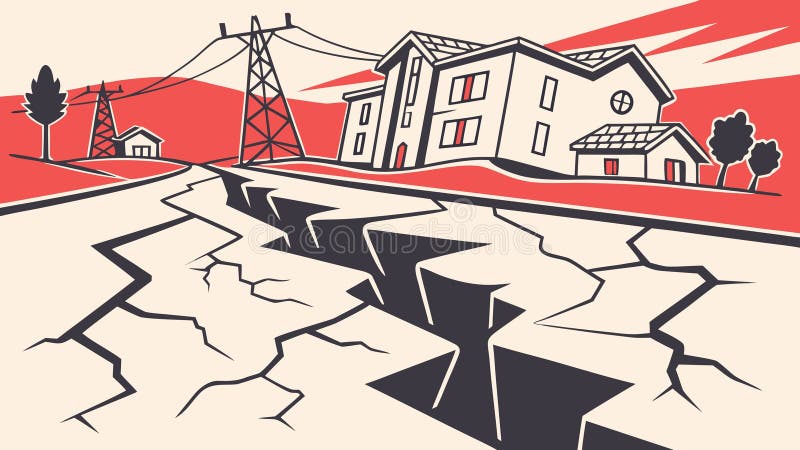
DANGER: Ground cracks visible. Heavy furniture overturned. Drivers lose control of vehicles.