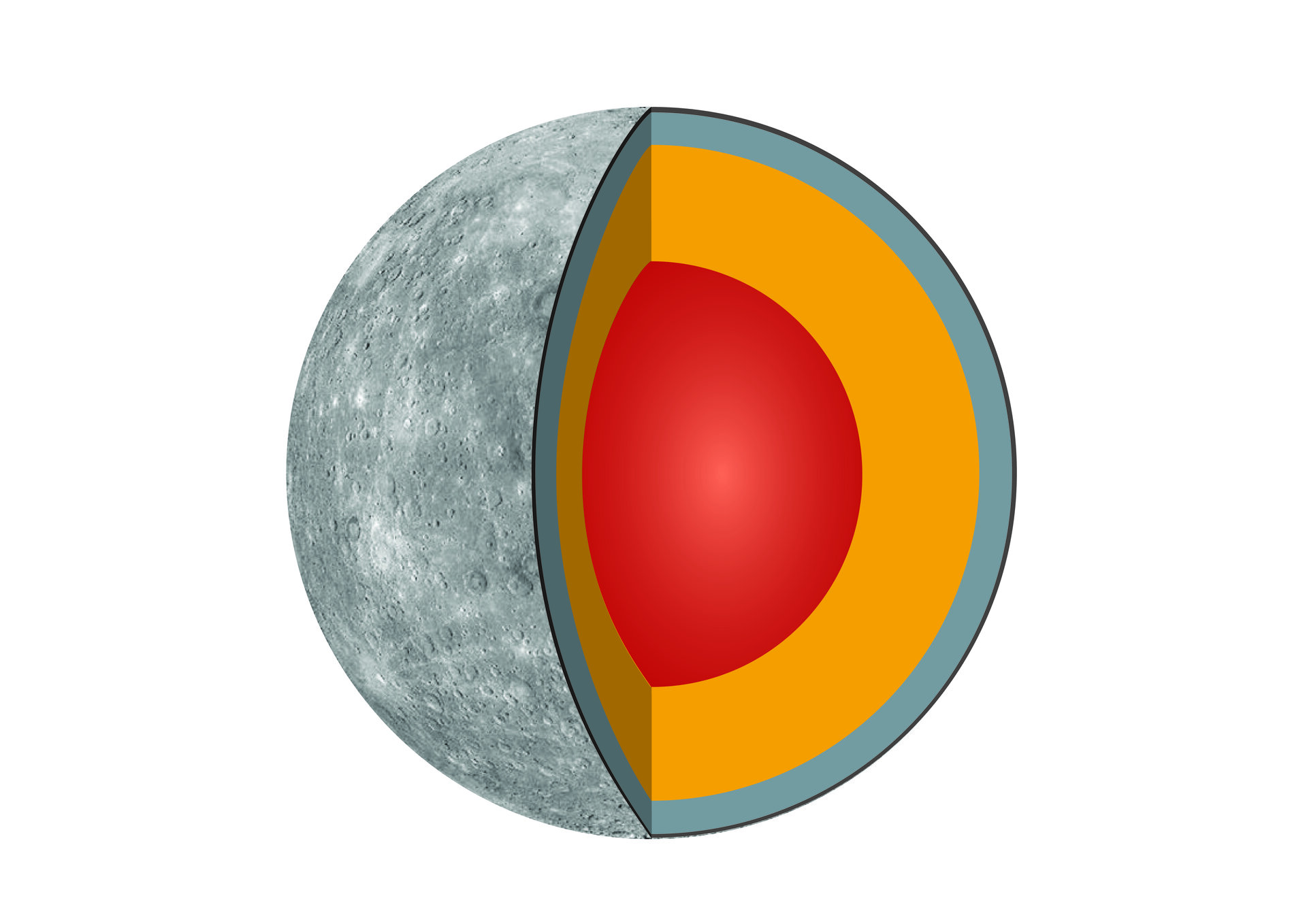
Mercury Core
IRON GIANT CORE
Massive Iron Core
Mercury's interior is dominated by a giant metallic core that takes up nearly 85% of its radius.
Out of 2,440 km total radius.
Molten outer core detected.
Iron Heart
Metallic Dominance. Mercury's core is a massive sphere of Liquid Iron that drives the planet's magnetic shield.
- 🦾 70% Mass: Most of the planet's weight is pure metal.
- 🧲 Dynamo: The molten outer core generates a magnetic field.
- 💥 Collision: Likely formed by a massive impact stripping its crust.
Geothermal Pulse
Deep Structure. Earth's core is a dual-layered engine of Liquid Motion and Solid Pressure that protects our atmosphere.
- 🔥 Solar Heat: The inner core is as hot as the Sun's surface.
- 🧲 Dynamo: Churning liquid metal generates our magnetic shield.
- 💎 Crystalline: Extreme pressure keeps the center solid.
Iron Heart
Metallic Core. Mercury is the most iron-rich planet in our system, with a core that defies standard Planetary Models.
- 🦾 82% Radius: The core extends nearly to the surface.
- 🧲 Active Dynamo: Molten iron generates a magnetic shield.
- 🧪 Iron-Nickel: Dense metallic composition drives high gravity.
Martian Core
The Liquid Heart. Mars hides a large, sulfur-rich Molten Core beneath its dusty, frozen surface.
- 📏 1,830 KM: A core that spans over half the planet's radius.
- 🧪 Sulfur Rich: High sulfur content keeps the iron liquid.
- 🧲 Silent Dynamo: No active magnetic field despite the liquid state.
Sources
MERCURY EXPLORATION
Deep dive into the smallest planet and its cratered landscape.
VISIT SITEESA - BEPICOLOMBO
Europe and Japan's joint mission to solve the mysteries of Mercury.
VISIT SITETHE PLANETARY SOCIETY
The world's largest non-profit space organization led by Bill Nye.
VISIT SITEJPL SOLAR SYSTEM
Real-time data and interactive 3D maps of our celestial backyard.
VISIT SITEMESSENGER ARCHIVE
Historic data from the first spacecraft to orbit Mercury.
VISIT SITESPECIAL THANKS TO NASA
We extend our deepest gratitude to NASA and the global scientific research community. The visual models and orbital dynamics are made possible through their commitment to space exploration.