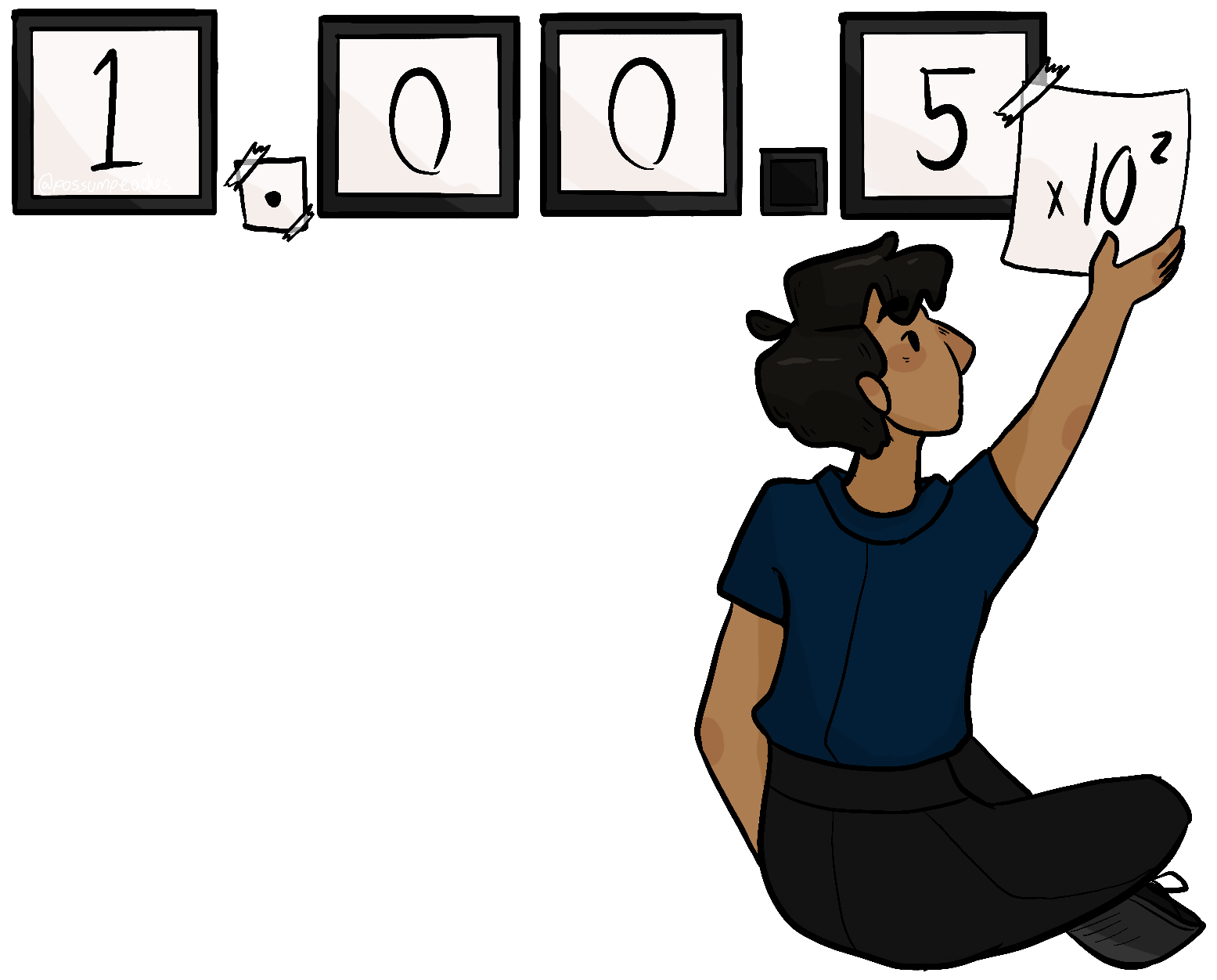
Scientific Notation
NOTATION CORE
Enter a value to calculate.
Scientific Notation
Scientific Notation is a standardized way of representing numbers that are either too large or too small to be conveniently written in decimal form. It simplifies complex data into a power-of-ten format.
- ● The Coefficient: The first part of the notation (m), which must be a number greater than or equal to 1 and less than 10.
- ● The Base & Exponent: Expressed as 10^n. The exponent (n) tells you how many places to shift the decimal point to reach the original value.
- ● Data Efficiency: In computing and "Oat" logic, this is often written as **E-Notation** , saving critical UI space.
The Zero Power
In scientific notation, 10⁰ (10 to the power of zero) is the mathematical identity. It serves as the baseline for all numerical conversions, representing a value that has not been scaled up or down.
- ● The Unity Rule: Any non-zero number raised to the power of zero equals 1. Therefore, 10⁰ = 1.
- ● Zero Shift: In the Oat Engine, an exponent of 0 means the decimal point stays in its original position. No movement is required to the left or right.
- ● Standard Form: Numbers between 1 and 9.99 are naturally represented by 10⁰. For example, 5 is written as 5.0 x 10⁰ (or 5.0E+0).
Engineering Scale
The Engineering Breakdown translates raw exponents into standardized physical scales. By grouping powers of ten, it helps users identify whether they are working with microscopic units or astronomical magnitudes.
- ● Significant Digits: Also known as the precision layer. This represents the core values (8.0000) before the exponent shift is applied.
- ● Exponent Shift: A directional movement. A "Right Shift" indicates a large number (positive power), while a "Left Shift" indicates a small decimal (negative power).
- ● Scale Identification: Maps exponents to SI prefixes. For example, a shift of 3 is "Kilo," while a shift of -6 is "Micro." Scales between -3 and 3 are labeled "Normal."
E-Notation Logic
The letter "E" stands for Exponent. It is a compact formatting style used by scientific calculators and programming languages to represent powers of ten without using superscripts.
- ● The "E" Replacement: The symbol "E" effectively replaces the phrase "x 10^". For example, 5.2E+3 is identical to 5.2 x 10³.
- ● The Plus (+) Sign: Indicates a positive exponent. 0.0E+0 means the value is at its base state, where ten is raised to the power of zero.
- ● Digital Clarity: E-notation prevents "overflow" on digital screens by keeping massive numbers (like 1,000,000,000) condensed into a short string (1.0E+9).
Multiplier: 10^0