Roche Limit Calc
TIDAL DISRUPTION
The Shatter Point
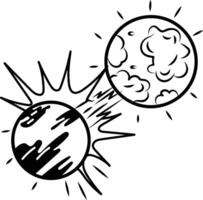
When a celestial body gets too close to a planet, the tidal forces overcome its internal gravity, tearing the body apart into debris.
Distance for icy objects.
Objects turn into rings.
Roche Sync
Tidal Disruption Mapping. Analyzing the 147,000 km "Shatter Constant" where moon integrity fails. The Oat monitors the Density Ratio to track ring formation boundaries.
- 💥 Shatter: Tidal Force > Self-Gravity.
- 💍 Rings: Permanent Debris Corridor.
- 📐 Limit: Approx. 2.44 Planetary Radii.
Shatter Sync
Tidal Tension Mapping. Analyzing the $d^3$ gradient constant that overcomes internal gravity. The Oat monitors the Tension Ratio to track moon disintegration events.
- 💥 Force: Tidal Gradient > Self-Gravity.
- 📐 Scaling: $1/d^3$ Disruption Law.
- 💍 Outcome: Debris Dispersion (Ring Formation).
Limit Sync
Anti-Accretion Mapping. Analyzing why the 147,000 km Roche boundary prevents moon formation. The Oat monitors the Shear Constant to track ring stability.
- 💍 Zone: A, B, and C Rings (Inside Limit).
- 📐 Force: Tidal Shear > Particle Gravity.
- ✨ Result: Permanent Brilliance / No Moon.
Destruction Sync
Structural Failure Mapping. Analyzing the 147,000 km collapse constant where internal moon gravity fails. The Oat monitors the Stress Ratio to track tidal disassembly.
- ❄️ Result: Billions of Ice Fragments.
- 📏 Boundary: 147,000 km Limit.
- ⚖️ Physics: Tidal Stress > Material Strength.
Fluid Sync
Hydrostatic Limit Mapping. Analyzing the 2.44x radial constant for non-rigid celestial bodies. The Oat monitors the Density Ratio to track fluid tidal disruption.
- 🌊 Physics: Hydrostatic Equilibrium Failure.
- 📐 Coefficient: 2.44 (Fluid) vs 1.26 (Rigid).
- 💍 Result: Rapid Ring Dispersion.
Paper
ROCHE LIMIT ANALYSIS 🌌
Randomized: 5 Questions from our 50-item Gravity Bank.
Sources
THE FLUID LIMIT
For a non-rigid body (like a loose pile of ice), the Roche limit is roughly 2.44 Rₚ (ρₘ/ρₛ)¹/³. For Saturn, this is about **147,000 km**.
DERIVATION MATHTIDAL DISRUPTION
Gravity pulls harder on the "near side" of a moon than the "far side." Inside the limit, this stretching force overcomes the moon's own self-gravity.
RING ORIGINSSMALL MOON SURVIVAL
Moons like Pan or Daphnis survive inside the limit because they are held together by **chemical bonds** (solid rock/ice) rather than just gravity.
MOONLET STATS