
Neptune
Neptune
The Wind Giant. A distant, frozen world where the winds scream at supersonic speeds and the atmosphere is a deep, methane blue.
- 💎 Atmosphere: Hydrogen, Helium, and Methane.
- 🌀 Weather: Home to the Great Dark Spot.
- 🛰️ Discovery: Predicted by math before being seen.
Neptune Ice
Beyond the Freezing Point. Neptune's "ice" isn't cold—it's a hot, superionic fluid where diamonds form and oxygen locks into crystals.
- 🧪 Composition: Water, Ammonia, and Methane.
- ⚡ State: Superionic (conducting protons).
- ✨ Pressure: Crushes Carbon into Diamond rain.
Internal Heat
The Frozen Furnace. Despite being 4.5 billion km from the Sun, Neptune's core is nearly as hot as the solar surface.
- 🌡️ Core Temp: Estimated at 5,100°C.
- 💎 Friction: Diamond rain generates thermal energy.
- 🌀 Drive: Heat powers 2,000 km/h winds.
Sonic Wind
Supersonic Chaos. Neptune's atmosphere moves faster than the speed of sound, driven by a 5,000°C internal furnace.
- 🌪️ Max Speed: 2,100 km/h (Mach 1.6).
- 🚀 Power: Driven by internal heat, not the Sun.
- 📉 Friction: Zero-drag fluid environment.
Retrograde Orbit
Triton's Path. Locked in a backward orbit, Neptune's largest moon is a captured world from the Kuiper Belt on a slow-motion collision course.
- 🔄 Direction: Opposite to Neptune's rotation.
- 📉 Fate: Spiraling inward due to tidal friction.
- 🌑 Origin: A captured KBO (Kuiper Belt Object).
Great Dark Spot
The Vanishing Storm. An Earth-sized window into Neptune's depths, the Great Dark Spot is a testament to the planet's supersonic atmospheric energy.
- 🌪️ Type: High-pressure Anticyclone.
- 📉 Nature: Transient (appears and disappears).
- ☁️ Altitude: Forms beneath methane cirrus clouds.
Cryo Geysers
High-Altitude Eruptions. Nitrogen gas erupting from beneath Triton's ice can reach 8km high, carried by the moon's low gravity and thin air.
- 📏 Height: Up to 8,000 meters.
- 🧪 Material: Nitrogen gas and carbon dust.
- 🌬️ Drift: Trails stretch for 150km.
The Scooter
Atmospheric Fast-Lane. This bright methane cloud outpaced every other feature on Neptune, "scooting" around the planet in under 17 hours.
- ⏱️ Rotation: 16.8 Hours (Super-fast).
- ☁️ Material: High-altitude Methane Ice.
- 🏎️ Velocity: Faster than the Great Dark Spot.
Solar Distance
The Inner Circle. Venus orbits in a near-perfect circle 108 million km from the Sun, receiving nearly double the solar energy of Earth.
- 📏 Avg Distance: 0.72 AU (108M km).
- 🌀 Orbit: Most circular in the solar system.
- ⚡ Energy: 1.9x Earth's solar Oat.
The Ice Giant

Classic Voyager 2 capture showing the Great Dark Spot.
Methane Haze
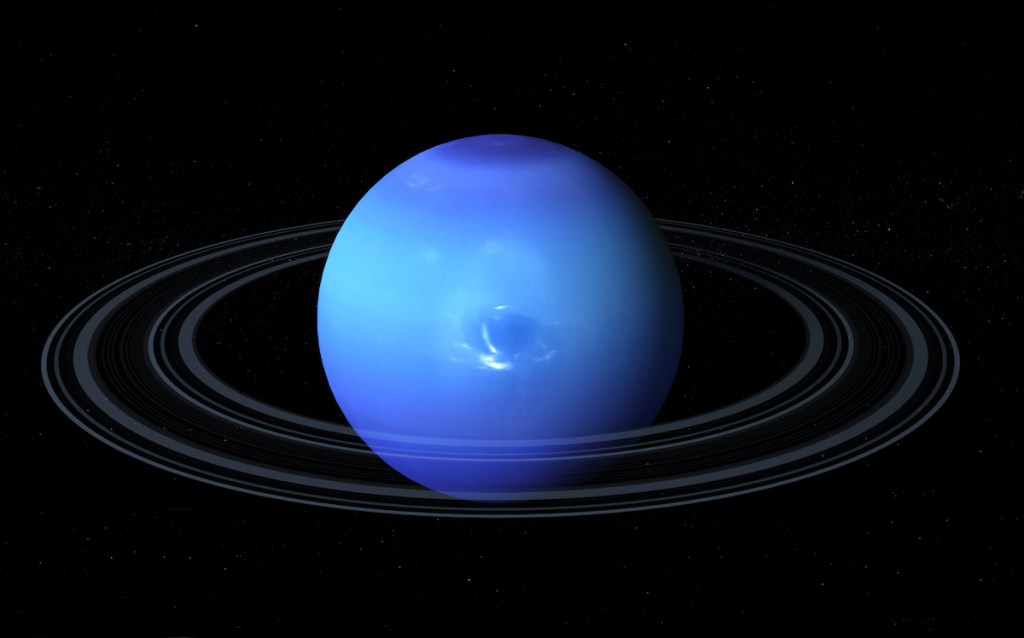
High-altitude clouds formed by the freezing of methane gas.
Cold World
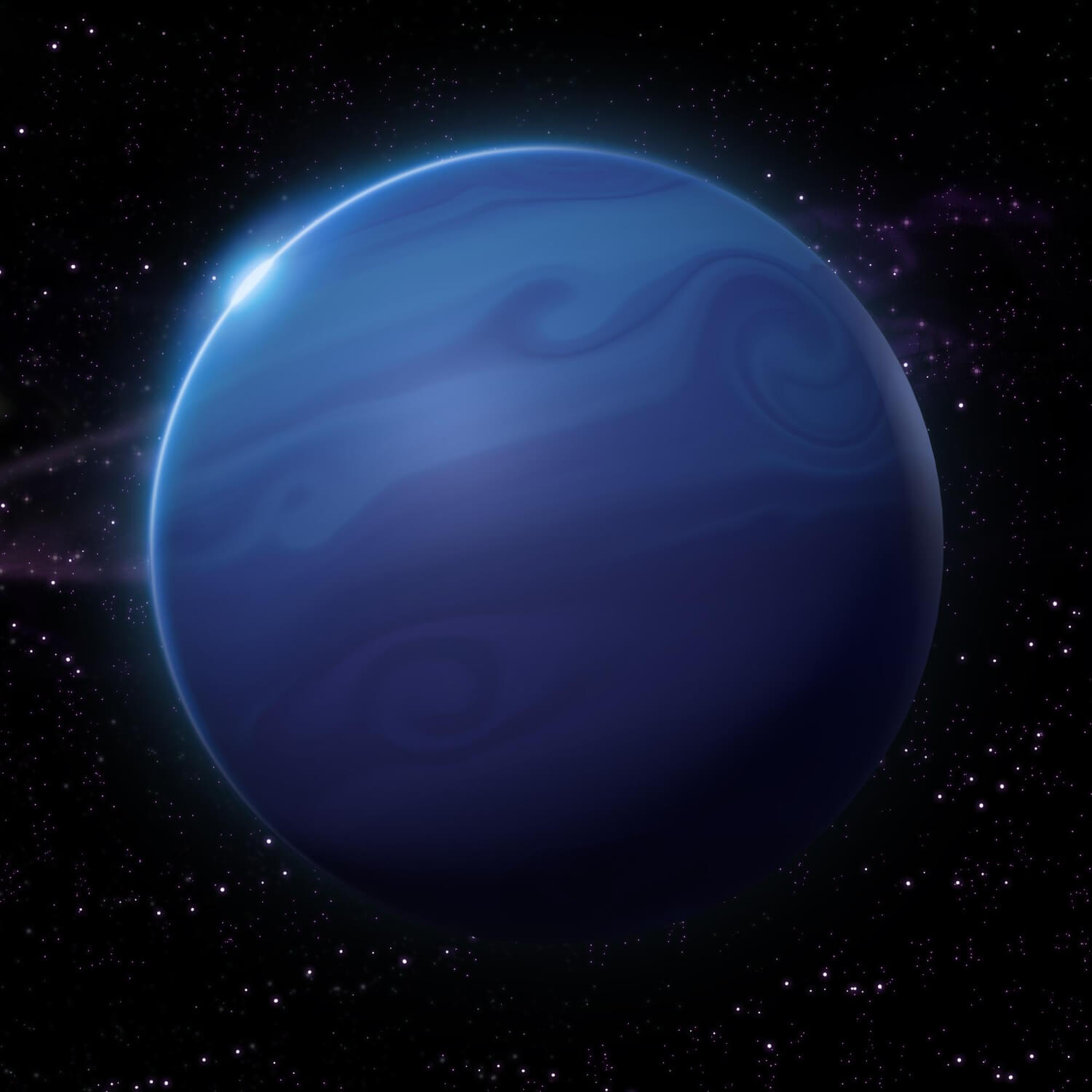
Wind Speed: Up to 2,100 km/h
Orbit: 165 Earth Years
Composition: Water, Ammonia, & Methane Ice
Paper
NEPTUNE LOG: VOYAGER 2 🛰️
Subject: Ice Giant Dynamics. Target: 8th Planet Orbit.
Sources
ATMOSPHERE
Mostly Hydrogen and Helium with traces of Methane. Home to the fastest winds in the solar system (2,100 km/h).
ATMOSPHERIC DATATEMPERATURE
Average temperature of **-214°C**, though it has an internal heat source that radiates twice the energy it receives.
THERMAL STATSORBITAL CYCLE
One year on Neptune lasts about **165 Earth years**. It has only completed one full orbit since its discovery in 1846.
ORBITAL DATA