
Neptune Spot
GREAT DARK SPOT MONITOR
Neptune Anticyclone
First discovered by Voyager 2, the Great Dark Spot is a massive anticyclonic storm system in Neptune's southern hemisphere, large enough to contain the entire Earth.
Kilometers per hour (Supersonic).
Current monitoring via Hubble Space Telescope.
Great Dark Spot
The Vanishing Giant. An Earth-sized vortex driven by supersonic winds, the Great Dark Spot represents the ultimate peak of planetary meteorology.
- 🌪️ Winds: 2,100 km/h (Mach 1.6).
- 📉 Lifespan: Highly transient; disappeared within 5 years.
- ☁️ Companions: Surrounded by methane ice "cirrus" clouds.
GDS-89 Discovery
1989 Telemetry. Voyager 2 revealed a world of supersonic winds and Earth-sized shadows, shattering our view of the outer solar system.
- 📡 Mission: Voyager 2 Grand Tour (1989).
- 🌀 Feature: Great Dark Spot (GDS-89).
- ☁️ Companion: The high-speed "Scooter" cloud.
The Disappearing Storm
Atmospheric Ghosts. Neptune's storms are not permanent landmarks, but dynamic events that appear and dissolve in the supersonic wind.
- 🔍 1989: GDS-89 spotted by Voyager 2.
- 💨 1994: Storm shredded by equatorial wind shear.
- 🔄 1995: New northern storm emerges (GDS-94).
Supersonic Vortex
Mach 1.6 Winds. On Neptune, the weather doesn't just blow—it breaks the sound barrier, pushing methane clouds at speeds that would shred an Earth hurricane.
- ⚡ Velocity: 2,100 km/h (Peak Recorded).
- 🌊 Shock: Kinetic energy creates high-altitude drag.
- 🔥 Source: Powered by Neptune's mysterious internal heat.
Paper
DARK SPOT LOG: NEPTUNE 👁️
Subject: Anticyclonic Vortex. Target: GDS-89 Coordinates.
Sources
VOYAGER DISCOVERY
In 1989, the spot was the size of Earth. By the time Hubble looked in 1994, it had completely vanished.
VOYAGER ARCHIVEATMOSPHERIC DYNAMICS
The GDS was an anticyclone with winds rotating counter-clockwise, accompanied by "Scooter," a small white cloud.
HUBBLE UPDATESRECURRING PHENOMENA
Since 1989, several other dark spots have appeared and disappeared, suggesting Neptune's weather is highly cyclical.
STORM CYCLESModern Vortex

Tracking the migration of dark spots across the northern hemisphere.
Vortex Depth
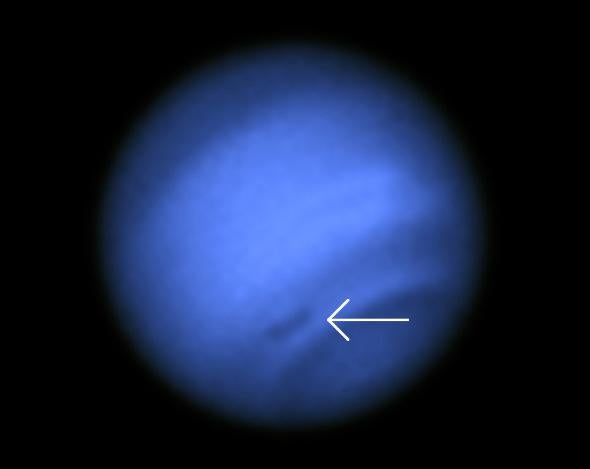
Mapping wind shears that drive anticyclonic storms at supersonic speeds.
Storm Data

Phenomenon: Dark Spot Oscillations
Mechanism: Convection of Hydrogen/Helium
Status: Transient Atmospheric Feature