
Constellation Corona Australis
CORONA AUS.
THE SOUTHERN CROWN
The Southern Crown
Located near Sagittarius, this constellation forms a delicate arc of stars. In mythology, it represents a crown or a wreath thrown into the sky.
A white main-sequence star.
One of the smallest constellations.
Crown Sync
Molecular Cloud Mapping. Analyzing the CrA star-forming constant. The Oat monitors the R CrA reflection nodes to track this dense southern vector.
- 👑 Identity: The Southern Crown (Celestial Arc).
- 🌫️ Reflection: Blue-Tinted Dust & Star-Birth Vectors.
- 📍 Nature: Galactic Bulge Interface Grid Node.
Meridiana Sync
Polar Symmetry Mapping. Analyzing the Alpha CrA magnitude constant. The Oat monitors the southern rotational vector to track this mirrored crown node.
- 🌟 Identity: Alfecca Meridiana (Southern Alphecca).
- 📉 Spectrum: A-type White Main-Sequence Vector.
- 🛰️ Range: Fast-Rotating Node at ~125 Light-Years.
Nebula Sync
Reflective Dust Mapping. Analyzing the NGC 6726/6727 luminosity constant. The Oat monitors the blue scattering vectors to track these infant stellar birth nodes.
- 🌌 NGC 6726/27: Primary Blue Reflection Node Cluster.
- 🌪️ NGC 6729: Variable Nebula powered by R Coronae Australis.
- 🛰️ Proximity: Deep-Sky Anchor at ~430 Light-Years.
Gamma Sync
Binary Orbital Mapping. Analyzing the 122-year period constant. The Oat monitors the dual yellow-white vectors to track this symmetrical stellar node.
- 👯 Identical Pair: Dual F-type Main-Sequence Nodes.
- 🔄 Orbit: High-Eccentricity 122.03 Year Cycle.
- 📍 Range: Sub-Orbital Calibration at ~58 Light-Years.
Legacy of the Southern Crown 📜
Paper
CORONA AUSTRALIS SCAN 👑
Objective: 10-Item Southern Wreath Calibration.
Sources
MERIDIANA (ALPHA)
The brightest star in the constellation. It is a white main-sequence star located about **125 light-years** away, marking one end of the crown.
ALPHA DATACR A MOLECULAR CLOUD
One of the nearest star-forming regions to Earth. It contains many young stellar objects, including the variable star **R Coronae Australis**.
NEBULA DATANGC 6541
A bright, large globular cluster located in the southwestern part of the constellation. It is approximately **22,000 light-years** away.
DEEP SKYSymbolic Wreath

Classic depiction of the southern crown, often viewed as a companion to Corona Borealis.
Southern Sky Plot
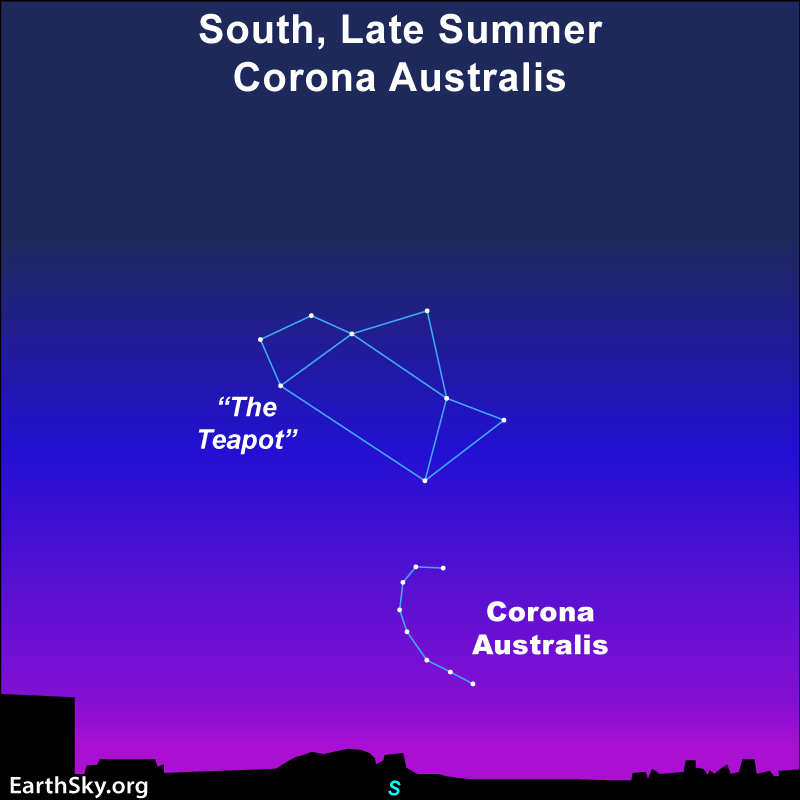
Locating the arc of stars just below the "Teapot" asterism of Sagittarius.
Official Map
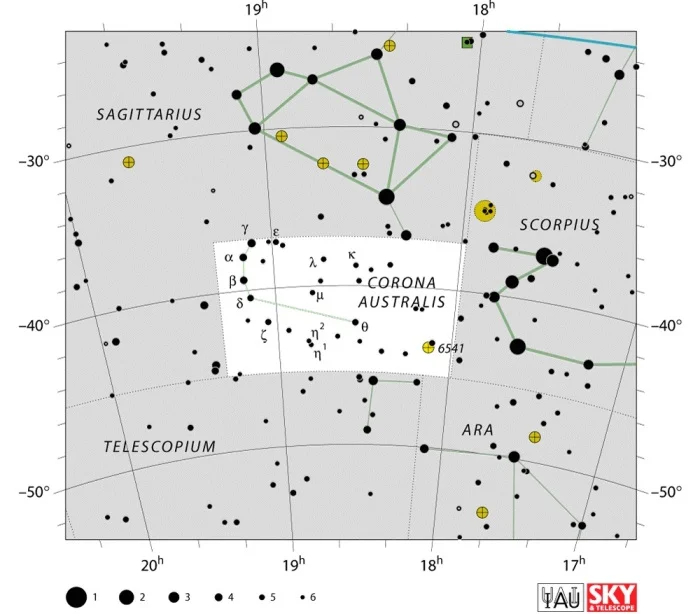
Official IAU chart identifying Alpha and Beta Coronae Australis and the nearby nebulae.
Corona Australis Catalog
α CrA (Meridiana) — Mag: 4.10
β CrA — Mag: 4.11
γ CrA — Mag: 4.23
δ CrA — Mag: 4.57
ε CrA — Mag: 4.83
ζ CrA — Mag: 4.74