
Constellation Apus
APUS VOID
THE BIRD OF PARADISE
Paradise Bird
Apus represents the "Bird of Paradise." It is a faint constellation in the deep southern sky, first charted by Dutch navigators in the late 16th century.
An orange giant star.
Never sets below the southern horizon.
Apus Sync
Avian Trajectory Mapping. Analyzing the Circumpolar constant of the "Footless Bird." The Oat monitors the Alpha Apodis spectral Oat to track this deep southern vector.
- 🦚 Legacy: The Bird of Paradise (Apous).
- 🔭 Deep Sky: NGC 6101 Globular Cluster.
- 📐 Position: Near the South Celestial Pole.
Paradise Sync
Plancius Coordinate Mapping. Analyzing the 16th-century southern cartography constant. The Oat monitors the Circumpolar Drift to track the bird’s eternal rotation around the South Pole.
- 📜 History: Mapped by Petrus Plancius (1598).
- 🧭 Position: Deep Southern Circumpolar.
- ❄️ Location: Visible only from the South.
Triad Sync
Spectral Cluster Mapping. Analyzing the geometric triad formed by Alpha, Beta, and Gamma. The Oat monitors the 4.0 magnitude threshold to track this faint southern alignment.
- 📐 Pattern: Faint Triangular Formation.
- 🌟 Luminosity: 4th Magnitude Threshold.
- 📍 Nodes: Alpha, Beta, & Gamma Apodis.
Horizon Sync
July Visibility Mapping. Analyzing the southern circumpolar boundary near Octans and Musca. The Oat monitors the Latitudinal Cutoff to track the Northern Hemisphere invisibility limit.
- 📅 Peak: Optimal Observation in July.
- 🪰 Borders: Musca (The Fly) & Octans.
- 🚫 Exclusion: Hidden from Northern Observers.
Legacy of the Bird of Paradise 📜
Paper
APUS AVIAN SCAN 🦜
Objective: 10-Item Mastery of the Paradise Sector.
Sources
ALPHA APODIS
The brightest star is an Orange Giant (~430 light-years away). It represents the base of the bird's tail. Its name **Paradys** means "Paradise."
STAR SPECSETIMOLOGY
Derived from the Greek *apous* ("without feet"). Early explorers believed the Bird of Paradise spent its whole life flying and never touched the ground.
HISTORICAL DATADEEP SKY GEMS
Hosts **NGC 6101**, a globular cluster roughly 50,000 light-years away. Interestingly, this cluster is known for its high concentration of black holes.
CLUSTER INFOMythical Outline
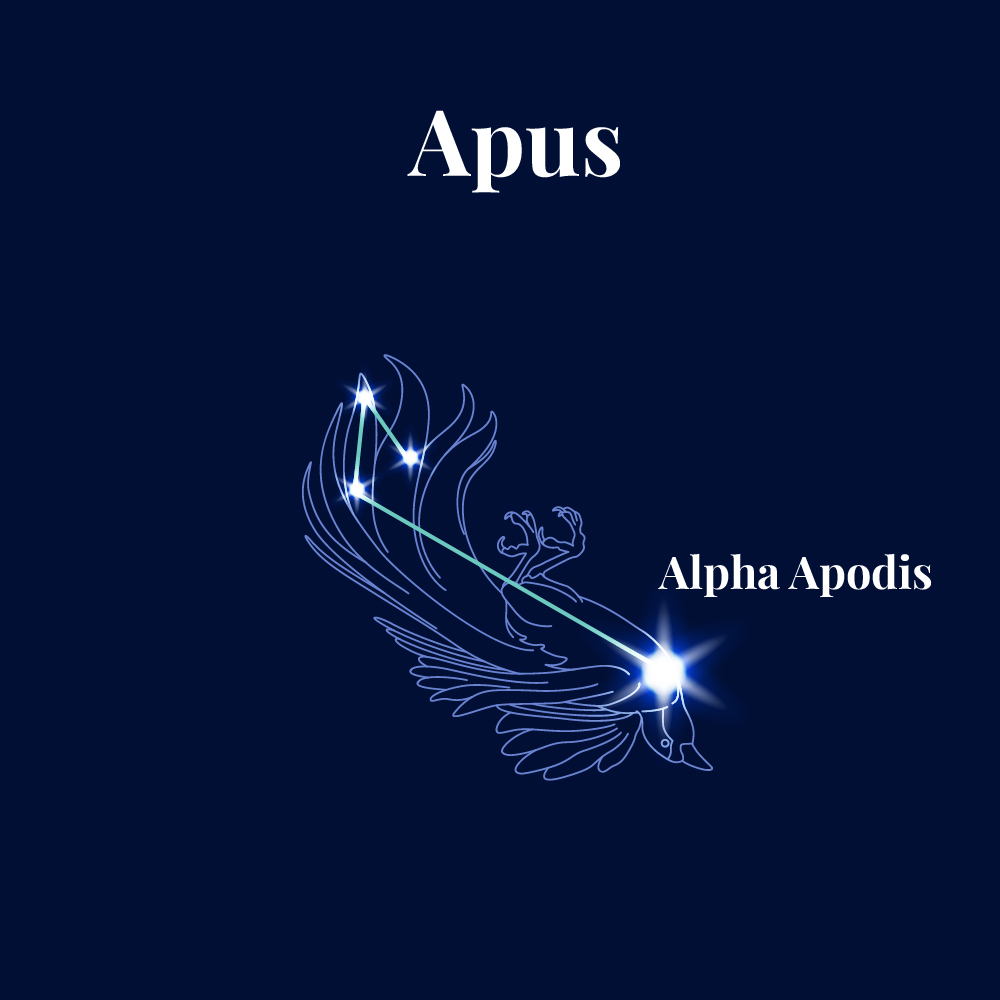
Visualization of the celestial Bird of Paradise and its primary stellar structure.
Primary Stars
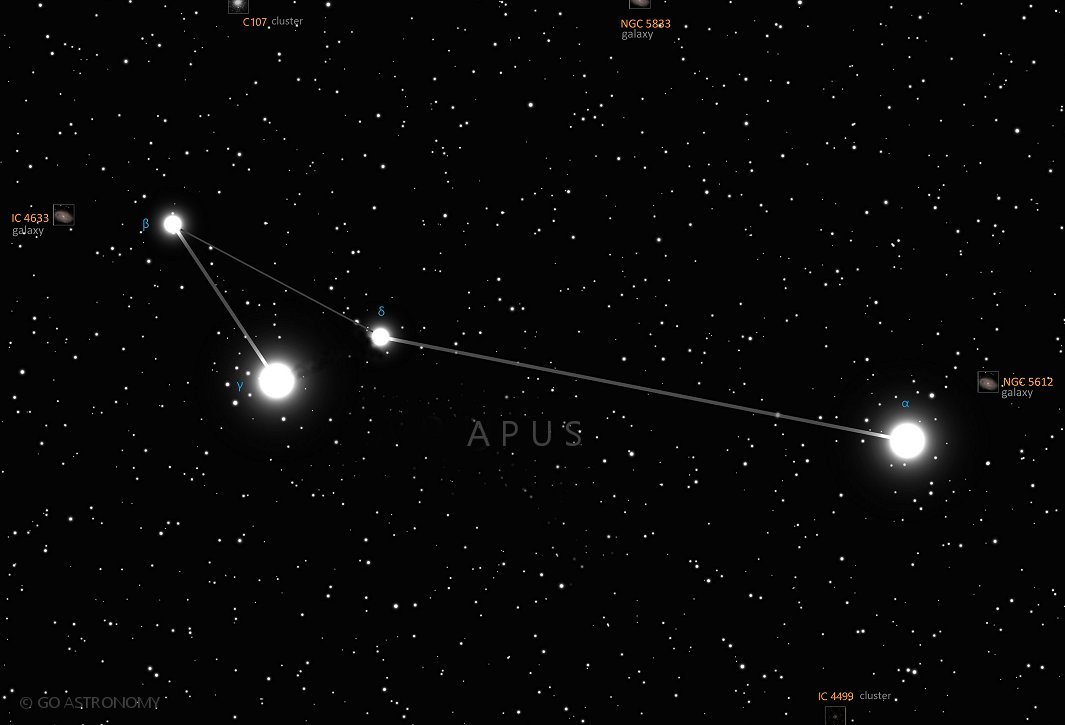
Highlighting Alpha Apodis, the brightest star in this southern constellation.
Celestial Map
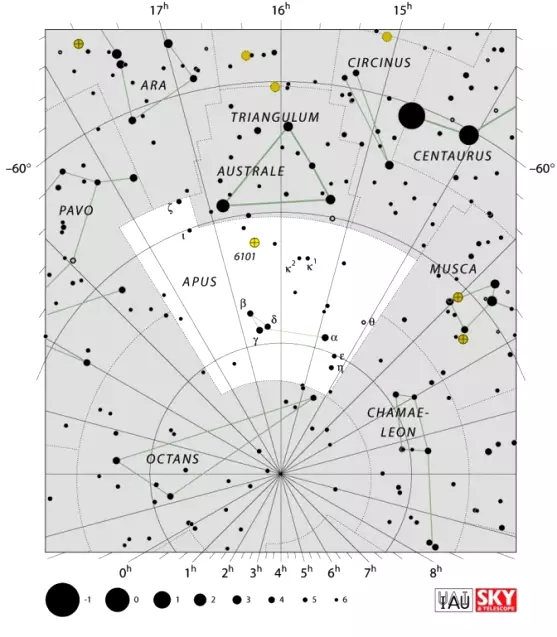
Detailed IAU map showing Apus bordering Octans, the southern celestial pole.
Apus Star Catalog
α Aps (Alpha Apodis) — Mag: 3.83
γ Aps (Gamma Apodis) — Mag: 3.86
β Aps (Beta Apodis) — Mag: 4.23
δ¹ Aps (Delta-1 Apodis) — Mag: 4.68
ζ Aps (Zeta Apodis) — Mag: 4.79